KYB Isn't a One-Time Check, It's a Living Profile [Part 2]
Date
Author
Trustform Team
What Makes Living KYB Possible
If KYB is moving toward a living, continuously updated profile, as we explored in Part 1, there is a more difficult question that follows immediately:
Why is this becoming possible now, when it wasn’t before?
Because the idea of the need itself is not revolutionary. Financial institutions have always understood that business data changes: from evolving ownership and management structures to risk shifts and AML monitoring list updates, to natural records decay over time.
The challenge has never been ideation. It has always been execution, and the technical challenge to overcome the status quo. Maintaining an accurate, up-to-date view of a business, without overwhelming compliance teams or frustrating clients, has historically been prohibitively expensive and operationally impossible.
And that pressure is by no means easing.
A 2025 report by TheCityUK, produced with PwC, found that regulatory compliance costs now account for over 13% of operating expenses in financial services. At the same time, PwC’s Global Compliance Survey shows that 71% of firms expect major digital transformation initiatives to require compliance involvement over the next three years.
In other words, compliance is no longer a supporting function. It hasn’t been for some time. Instead, it is becoming a core part of how institutions scale. Yet much of KYC & KYB still relies on a model built around manual input, periodic review, and duplicated effort.
Until recently, there was no viable alternative.
The Role of AI in Making, and Keeping, KYB “Alive”
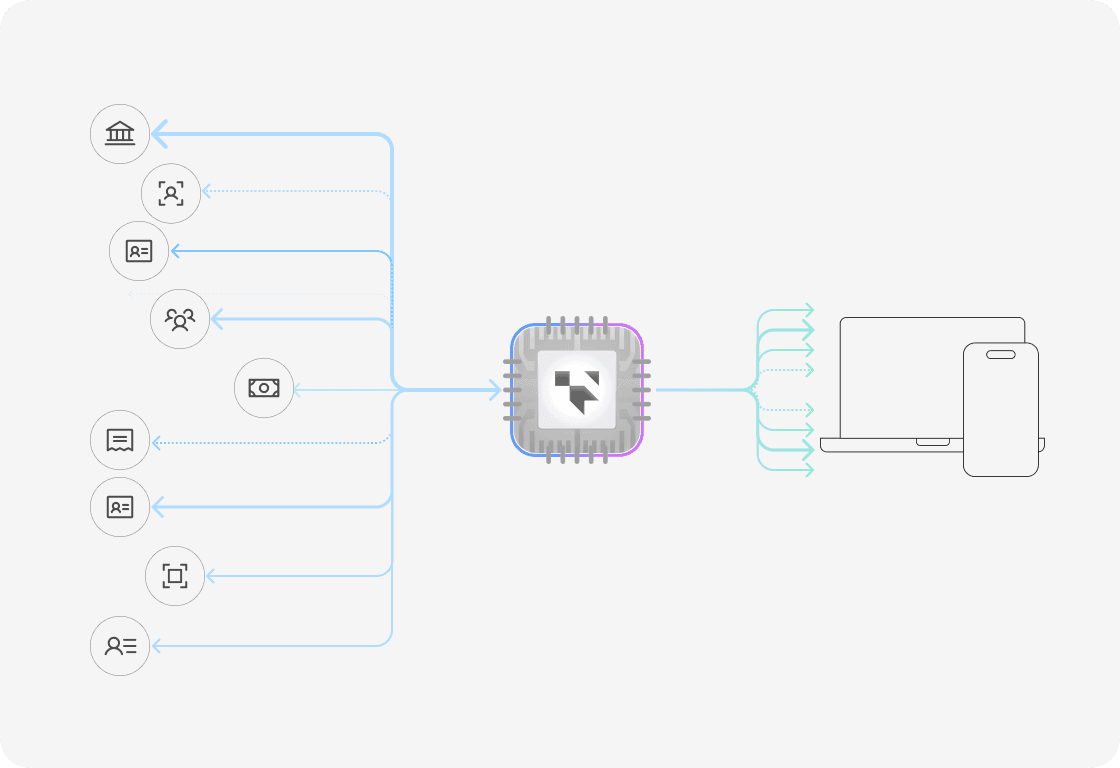
What changes the equation is not simply more data but the ability to process, structure, and maintain that data continuously.
This is where AI becomes meaningful – not as a trendy must-have feature, but as a core mechanism for data processing that makes living KYB operationally viable.
At onboarding, AI addresses one of the biggest sources of friction: data capture. Instead of asking clients to manually input large volumes of information, data can be extracted from documents, validated against registries, and structured automatically. What once required back-and-forth communication can now be completed faster, with greater consistency and fewer errors.
But the more important shift happens after onboarding.
AI enables the continuous ingestion and interpretation of new information. Changes in corporate registries, ownership updates, sanctions exposure, or emerging risk signals can be detected and incorporated into the client’s risk profile as they occur.
This is the difference between periodic KYB and continuous KYB.
And the scale of that shift is no longer theoretical. McKinsey’s 2025 work on agentic AI in financial crime describes KYC operations where a single practitioner can supervise dozens of AI agents, with productivity gains measured in multiples. BCG reports similar outcomes, with banks using GenAI to reduce KYC costs and significantly accelerate case handling.
This does not just improve efficiency. It removes the primary constraint that made living KYB impractical in the first place.
From Reprocessing to Change Detection
For years, KYC & KYB have been built around repetition: Collect the data. Verify it. Store it. Then repeat the process at the next review cycle.
A living KYB model, enabled by AI, changes that logic.
When data is continuously maintained and structured, institutions no longer need to repeatedly collect and verify the same information. Instead, they can focus on what has changed, rather than reprocessing what has not. This is a subtle shift, but a fundamental one.
It moves KYB from a process of reconstruction to one of maintenance.
Operationally, that reduces cost and complexity. From a risk perspective, it improves visibility by aligning compliance processes with how businesses, and threats, actually evolve.
And from a client perspective, it removes one of the most persistent sources of friction in financial services: being asked for the same information, over and over and over.
Why This Moment Matters
This shift is happening now because several constraints are breaking at the same time.
Data is more accessible and structured than it was a decade ago. Compute power makes continuous processing viable. And AI can now interpret and act on that data at scale.
At the same time, the external environment is becoming more dynamic. Recent fraud and financial crime data shows increasing use of AI-driven techniques, faster attack cycles, and more complex ownership structures. Static, point-in-time verification is becoming less effective against a moving target.
In that context, living KYB is not just a subtle efficiency upgrade, but a business viability requirement.
Data sources
TheCityUK + PwC report (2025) https://www.thecityuk.com/our-work/reducing-the-cost-of-compliance/
PwC Global Compliance Survey (2025) https://www.pwc.com/gx/en/issues/risk-regulation/global-compliance-survey.html
McKinsey (2025 – Agentic AI in Financial Crime) https://www.mckinsey.com/capabilities/risk-and-resilience/our-insights/how-agentic-ai-can-change-the-way-banks-fight-financial-crime
BCG (2025 – GenAI in KYC / Compliance)
Experian / Fraud Trends (2025–2026) https://www.experian.com/blogs/insights/2026-identity-fraud-report/
FATF (Beneficial Ownership – current guidance) https://www.fatf-gafi.org/en/publications/Fatfrecommendations/Guidance-Beneficial-Ownership-Transparency-Legal-Arrangements.html