AI for KYC: How to Use AI for Smarter Compliance & Automation
Date
Author
Trustform Team
KYC processes are often too complex, too manual, and too resource-intensive for many mid-sized firms to manage efficiently.
AI can help by improving accuracy, reducing false positives, and strengthening risk detection, while also cutting the time and effort needed to complete compliance tasks.
The global market for AI-powered KYC automation was valued at $1.45 billion and is expected to grow to $8.92 billion by 2033, with a strong CAGR of 22.7% over the forecast period. Such rapid market growth reflects strong interest in AI-driven automation, as organisations recognise its impact on KYC operations and risk management.
Read on to learn where AI for KYC adds the most value and how it supports more effective compliance decision-making.
Key takeaways
Traditional KYC processes struggle to scale
Manual document reviews, fragmented customer data, and high false-positive rates create problems that slow onboarding and increase compliance costs. As customer volumes grow, these challenges make it harder for compliance teams to maintain efficiency and consistency.AI can automate the most time-consuming KYC tasks
AI streamlines document verification, customer onboarding, and data validation by automatically extracting information and identifying inconsistencies.AI improves risk detection and prioritisation
AI-powered risk scoring continuously evaluates customer behaviour, transaction activity, and other risk indicators to identify higher-risk customers more accurately.Continuous monitoring strengthens compliance controls
AI can monitor sanctions updates, adverse media, ownership changes, and unusual customer activity in real time. Instead of relying solely on periodic reviews, compliance teams can respond to new risks in real time and reduce potential blind spots.A compliance orchestration platform can turn AI into measurable results
While individual AI tools can improve specific KYC tasks, Trustform combines identity verification, risk assessment, AML screening, monitoring, and continuous reviews in a single workflow. Organisations can reduce operational complexity, improve compliance efficiency, and scale customer onboarding without a proportional increase in headcount.
What makes traditional KYC processes challenging?
Traditional KYC processes cater to lower customer volumes and less complex regulatory systems.
Although these approaches still meet basic compliance requirements, they rely on manual document reviews and relatively simple screening workflows for smaller-scale operations. When customer volumes increase, these fragmented processes become difficult to manage.
Manual document reviews are time-consuming and can create noticeable backlogs when onboarding volumes increase. In addition, many legacy screening systems generate large numbers of false positives, leading to even more time spent checking alerts that ultimately pose little to no risk.
Fragmented customer data spread across multiple systems is yet another important factor that makes it hard to build a complete customer profile or perform consistent checks.
As the company grows, these inefficiencies become more obvious, leading to higher operational costs and the need to hire additional staff, which is usually unsustainable for mid-sized organisations.
To support larger-scale operations, compliance processes need to reduce reliance on manual reviews, improve data consolidation across systems, and ensure screening outputs are more accurate.
How to use AI for KYC: 5 practical ways
AI has the greatest impact when you apply it to specific, high-volume processes where it can improve precision, reduce manual workload, and strengthen risk detection.
Below are the key ways AI enhances KYC.
Use case | What AI does | Key benefits |
Automate document verification | Extracts and validates data from IDs, passports, proof-of-address, and company documents using OCR and ML | Faster onboarding, reduced manual review, lower abandonment rates, and improved auditability |
Improve customer risk scoring | Uses machine learning to assess risk dynamically based on demographics, transaction patterns, geography, and behaviour data | More consistent risk assessments, better prioritisation, and enhanced detection accuracy |
Do continuous monitoring and periodic reviews | Continuously tracks internal and external risk signals and triggers reviews | Reduced blind spots, more targeted reviews, lower workload, and scalable monitoring |
Screen adverse media and news | Continuously scans global news and regulatory sources to identify relevant negative information and contextual risk signals | Earlier risk detection, fewer false positives, and better focus on important alerts |
Strengthen entity resolution and sanctions/PEP screening | Matches and consolidates fragmented identity data using multiple attributes | Reduced false positives, fewer missed matches, and improved cross-border screening accuracy |
1. Automate document verification
Verifying identity documents, extracting customer information, validating business registration records, and identifying inconsistencies are all necessary steps, but they are highly repetitive and resource-intensive.
AI-powered document verification automatically extracts and validates information from passports, driver’s licenses, proof-of-address documents, corporate filings, and other onboarding materials.
Using technologies such as OCR and machine learning, AI can quickly capture key customer data, compare it with the provided information, and identify inconsistencies that need further review.
As a result, stronger verification controls improve fraud detection and support regulatory compliance objectives. This also improves auditability by providing users with structured records of verification steps and outcomes.
For example, a mid-sized fintech onboarding international customers can automatically process thousands of identification documents daily, marking only high-risk or ambiguous cases for human review.
Worth knowing:
Trustform is a KYC/AML orchestration platform that helps companies manage onboarding, screening, ongoing monitoring, and reviews within a single workflow.
Our integrated verification solution enables automated identity authentication through biometric checks directly on the platform, which reduces manual review time.
We validate the document’s template, font, and data consistency to identify potential signs of fraud. In addition, we monitor the expiry dates of identity documents to keep data accurate and up to date, and we send you timely alerts.
2. Improve customer risk scoring
AI can improve the effectiveness of KYC in customer risk scoring and profiling by moving beyond static, rules-based approaches.
Using supervised learning models, you can train algorithms on historical data, such as previously identified suspicious activity, confirmed fraud cases, and compliant customer behaviours, to predict the risk level of new and existing customers.
These models analyse a wide range of inputs, including customer demographics, transaction patterns, geographic exposure, changes in corporate ownership, adverse media mentions, sanctions updates, or deviations from expected activity patterns.
As a result, they can generate dynamic and continuously updated risk scores. This way, they can capture subtle patterns that traditional rules might miss, which can improve detection accuracy.
The approach delivers two key advantages: consistency and prioritisation.
AI-driven risk scoring ensures that similar customer profiles are evaluated systematically, which reduces subjectivity and variability across analysts. It also enables more effective resource allocation by prioritising high-risk cases for further review.
This level of transparency supports auditability and helps compliance teams justify decisions during regulatory reviews.
3. Do continuous monitoring and periodic reviews
By continuously analysing internal and external data signals, AI systems can identify meaningful changes in customer risk profiles in real time.
When changes are detected, the system can trigger targeted reviews instead of waiting for the next scheduled cycle.
The shift from periodic to continuous monitoring means you can focus on cases where risk has changed, rather than reviewing all customers on a fixed timetable.
This method improves the quality and relevance of reviews and reduces unnecessary workload. In addition, it reduces compliance blind spots and allows you to scale monitoring capabilities without increasing headcount.
4. Screen adverse media and news
Information about financial crime, regulatory enforcement actions, fraud allegations, corruption investigations, or other reputational concerns often appears in the media long before it is added to official sanctions or watchlists.
AI monitors thousands of news sources, regulatory publications, and publicly available information channels in real time. The AI-driven approach maps and analyses relationships among individuals, organisations, addresses, and other identifiers to provide a more contextual and precise understanding of risk.
For example, a customer may not appear on a sanctions list directly but could be linked to a sanctioned entity through ownership structures, shared directors, or transactional networks.
You can discover these connections and evaluate overall risk while aligning with regulatory expectations for beneficial ownership transparency and network-based risk assessment.
The process enables compliance teams to spend less time reviewing false positives and more time focusing on credible risks. In addition, teams can identify threats earlier, so companies can respond before those issues lead to larger compliance or reputational problems.
Worth knowing:
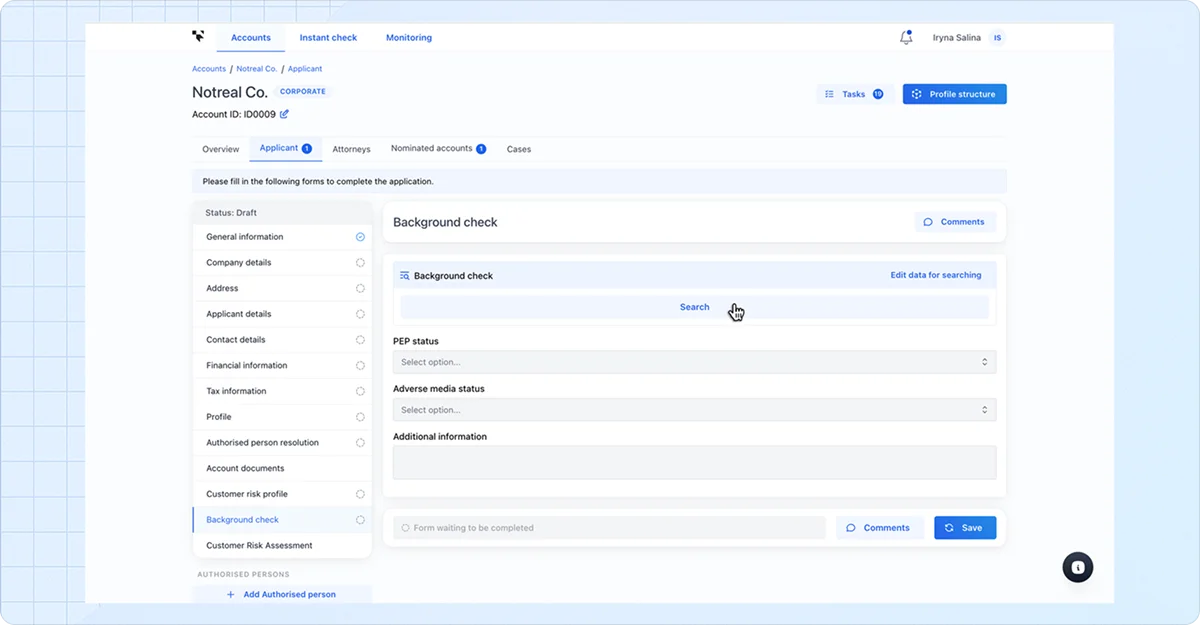
Our integrated AML screening solution cross-references the applicant’s name against connected sanctions lists, PEP databases, and adverse media sources.
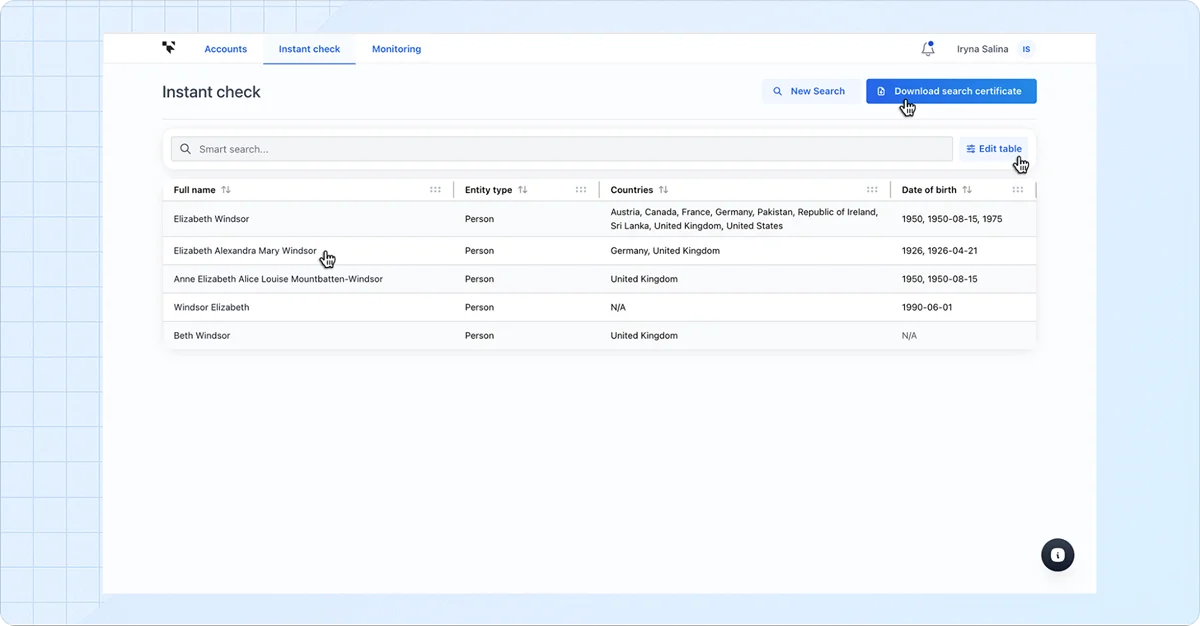
You can see all potential matches filtered by entity type, country, and date of birth, with a detailed view of sanctions source data and links to external articles.
5. Strengthen entity resolution and sanctions/PEP screening
Entity resolution models consolidate fragmented or inconsistent data into a single customer profile.
For example, variations in spelling, transliteration differences, or incomplete records can lead to duplicate or missed matches in legacy systems.
In addition, AI models evaluate multiple attributes simultaneously, such as name, date of birth, nationality, and network connections, to determine whether records refer to the same entity even when individual fields are inconsistent.
This capability is practical if your company operates across jurisdictions where data quality and formats vary significantly.
Also, it enables a more accurate distinction between true matches and unrelated entities that may appear similar.
Worth knowing:
With Trustform, you can run ad-hoc AML screening for an individual or a company using smart search by name or title.
How to automate KYC and stay compliant with Trustform
Trustform is a compliance orchestration platform that provides solutions for KYC, KYB, and AML processes.
We centralise all aspects of client lifecycle management, including complex corporate onboarding, risk assessment, ongoing due diligence, and transaction monitoring.
One of the main perks is that users only need to provide and verify identity information once, and they can then reuse that same verified data across different services, banks, or platforms – they don’t have to start the KYC process all over every time.
With Trustform, you can also:
Automatically log all client interactions, document updates, and compliance actions in audit trails, for full traceability and accountability
Capture and manage beneficial ownership information, entity hierarchies, and relationship networks for complex client arrangements
Scale compliance operations efficiently as client volumes increase without proportionally increasing headcount or operational complexity
Get automated reminders and review schedules to track expiring documents, periodic reviews, and ongoing due diligence requirements
Interested in learning more?
Book a demo today to see how you can improve KYC processes with reliable, structured data within a single platform.
FAQ:
1. What are the 4 types of AI KYC risks?
AI KYC risks fall into four categories: model risk, data risk, governance and compliance risk, and operational risk.
They relate to the accuracy of model outputs, the quality of underlying data, the ability to explain and govern AI decisions, and the effective integration of AI within compliance frameworks.
2. How can highly regulated industries use AI for KYC?
They can use AI to automate identity verification, document checks, and screening against sanctions or watchlists, while keeping human oversight for higher-risk cases.
AI helps process large volumes of data faster and more consistently, which reduces manual errors and onboarding time.
However, organisations must combine AI with strong governance, audit trails, and explainability to meet regulatory requirements and ensure decisions can be reviewed and justified.
3. How is AI used in AML compliance?
AI in AML compliance analyses transaction data, identifies suspicious patterns, and detects potential money laundering activity more quickly and accurately.
It can automate ongoing monitoring and improve the quality of alerts by reducing false positives and prioritising higher-risk cases.