Your bank wants your company's ownership documents again, years after you opened the account. A new client's supplier portal asks for the same certificate of incorporation, director IDs and shareholder list, in its own format. A large payment sits on hold while you explain where the money came from.
So you search for answers: why is my bank asking for documents again, what do they actually need, and will the new EU digital identity wallet mean I never have to do this twice? The last question is the one this guide answers.
Why your bank asks again. Customer due diligence is an ongoing obligation, not a one-off check at account opening. Under existing EU anti-money laundering rules, including Article 13 of Directive (EU) 2015/849 as applied by national law, banks must monitor business relationships and keep customer information up to date.
Changes in ownership, control, activity or risk can trigger further verification, and unusual transactions can lead to questions about the source of funds.
Here is the short answer.
By the end of 2026, every EU Member State must offer at least one EU Digital Identity Wallet (EUDI Wallet), under Regulation (EU) 2024/1183.
Your company does not have to adopt one. The EUDI Wallet is built first around proving who a person is, such as you as a director. The framework also covers legal persons, but support for company evidence is still developing. A separate European Business Wallet, built for companies, is still being negotiated in Brussels.
So what really changes? From 24 December 2027, certain banks and other regulated providers must accept the EUDI Wallet for online identification, when you choose to use it and the conditions of Article 5f(2) apply.
That is intended to make proving who you are simpler. It does not prove who owns your company, who can sign for it, or where a large payment came from. That evidence is still yours to keep current.
This guide explains both wallets, the dates that matter and what to prepare now.
In short:
No obligation for your company. The rules require Member States to offer wallets and some providers to accept them. They do not require businesses to use one.
People first, companies later. The EUDI framework covers people and legal persons, but the rollout starts with personal identity. No widely deployed credential yet covers a company's full ownership and control.
Two deadlines to remember. End of 2026: wallets available. 24 December 2027: certain regulated providers, including qualifying banks, must accept them for online identification when you ask.
The European Business Wallet is not law yet. Talks between the Parliament and the Council began in October 2026, with a deal targeted for the end of 2026.
What helps now: a complete, current company record you can share in part, whatever wallet or portal the next request arrives through.
What is the EU digital identity wallet?
The EU Digital Identity Wallet is an app that lets people prove who they are online and share verified details about themselves, choosing what to share and with whom. It was created by Regulation (EU) 2024/1183, often called eIDAS 2, which updated the EU's rules on electronic identification.
Each Member State must make at least one wallet available by the end of 2026, either directly or through an approved provider. For individuals it is free and voluntary. The regulation covers legal persons too, and the Commission presents the wallet as usable by businesses. In practice, the first wave of national wallets is built around people.
The wallet can hold three kinds of things:
Person identification data: your name, date of birth and nationality, issued by your country.
Attestations of attributes: verified statements about you, such as a driving licence or a qualification.
Signatures: the ability to sign electronically.
Why this matters less for your company than the headlines suggest
The technical rulebook behind the wallets, the Architecture and Reference Framework that sits under the EUDI Regulation, has focused its common specifications on personal identity and the mobile driving licence.
Pilot projects have tested credentials for legal persons, but no widely deployed, interoperable credential yet covers a company's full ownership and control structure.
That does not mean companies are left out by design. The implementing rules on person identification data, Implementing Regulation (EU) 2024/2977, already define a basic dataset for legal persons: the current legal name and a unique identifier, with optional details such as a VAT number or LEI. That proves which company it is. It does not show who owns or controls it.
In practice, the EUDI Wallet can speed up the part of onboarding that checks you.
Standard, widely accepted ways to carry your certificate of incorporation, shareholder structure, or a board resolution are still developing. That gap is what the European Business Wallet is meant to help close.
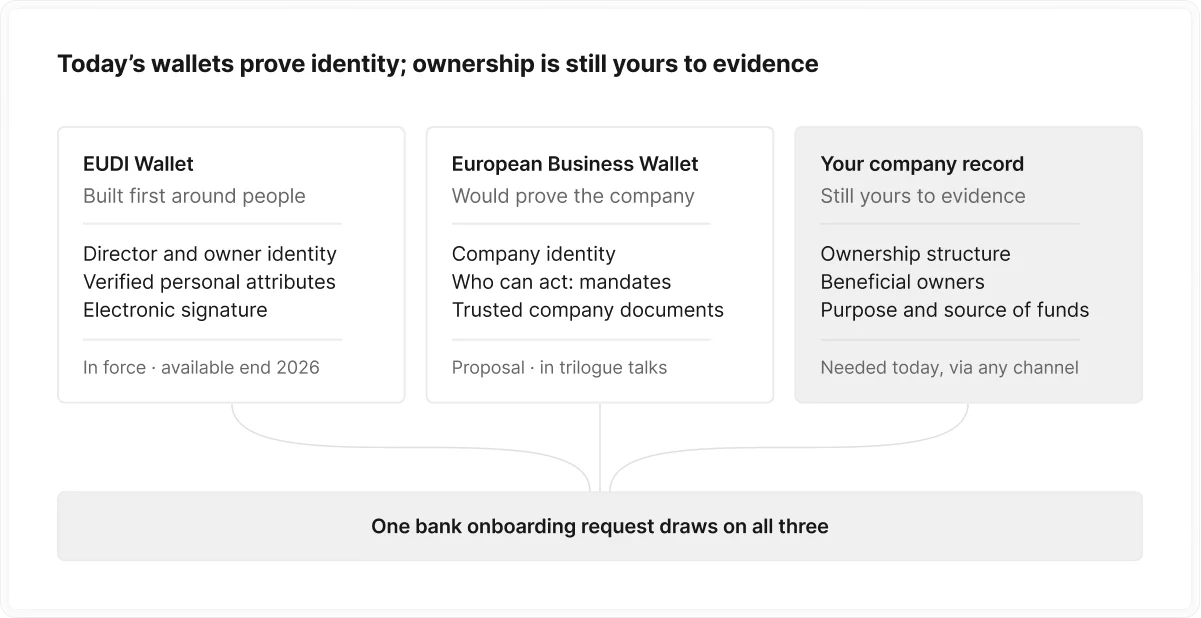
Who proves what · EUDI Wallet, European Business Wallet, your company record
Today the EUDI Wallet is most useful for the people in your company; the proposed business wallet is designed for the company itself. Either way, evidence of ownership, beneficial owners, and source of funds still comes from your own records.
EU digital identity wallet vs European Business Wallet
The two names sound alike, but they are separate laws at different stages. One is in force; the other is still being negotiated.
EU Digital Identity Wallet | European Business Wallet | |
|---|---|---|
Status (21 Oct 2026) | In force under Regulation (EU) 2024/1183 | Proposal COM(2025) 838, in trilogue negotiations |
Built for | People first; legal persons can also use it | Companies and other economic operators, and public bodies |
Proves | People's identity first; legal persons in scope, support still developing | Who a company is, who can act for it, and trusted company documents |
Key capabilities | Identification, attestations, selective sharing, e-signatures | Company identity, mandates and delegation, signing and sealing, secure document exchange |
Next milestone | Available in every Member State by end of 2026 | Political agreement targeted by end of 2026 |
Must your company use it? | No | No — under the proposal, businesses are not obliged to use it |
Who must accept it | Public services using e-ID; qualifying private providers, for online identification, by 24 Dec 2027 (Art. 5f(2)) | Public sector bodies, 24 months after the regulation enters into force (Commission proposal) |
Where the European Business Wallet stands
The European Commission proposed the European Business Wallet on 19 November 2025. Under the proposal, actions taken through a business wallet would have the same legal effect as acting in person or on paper. Public bodies would have to accept the wallets, but companies would remain free to use them or not.
The Council of the EU adopted its negotiating position on 9 June 2026. It stressed that business wallets should work alongside existing national systems and that national procedural rules still apply.
The European Parliament's industry committee backed its position on 10 September 2026, adding a requirement that wallet data stay on EU territory. The Parliament confirmed its mandate in October, and trilogue talks between the institutions began the same month.
Until a final text is adopted, treat any detail of the business wallet as provisional. You can follow the file under procedure 2025/0358(COD).
The dates that matter
Wallet availability and wallet acceptance are different deadlines, a year apart. The table lists them in order; the ones that affect a typical company are in bold.

EU digital identity timeline · Nov 2025 to Dec 2027
The business wallet is still moving through negotiation, while the personal wallet's deadlines are fixed: available by the end of 2026, with acceptance duties for qualifying providers, including banks, from 24 December 2027. A hollow marker means a target, not a legal deadline.
Date | What happens | Type | What it means for you |
|---|---|---|---|
19 Nov 2025 | Commission proposes the European Business Wallet | Milestone | Nothing yet; proposal only |
9 Jun 2026 | Council adopts its negotiating position | Milestone | Member States back the idea, with national systems kept |
Oct 2026 | Parliament and Council begin trilogue talks | Milestone | Final text still open |
End of 2026 | Every Member State must offer an EUDI Wallet | Legal deadline | Directors and owners can start to get a wallet, depending on national rollout |
End of 2026 | Political agreement on the European Business Wallet | Political target, not a deadline | Then formal adoption and a rollout period |
10 Jul 2027 | EU AML Regulation applies | Legal date | Electronic identification becomes a recognised way to verify a person's identity; full due diligence still applies |
24 Dec 2027 | Qualifying private providers must accept the EUDI Wallet for online identification | Legal deadline, calculated (36 months after the implementing acts) | Your bank may have to accept it, if you ask and Article 5f(2) applies |
24 months after entry into force | Public bodies must accept business wallets (Commission proposal) | Proposed, may change | Filings and public procurement start to change |
The 24 December 2027 date comes from Article 5f(2) of the amended eIDAS Regulation. It applies to private providers that must use strong user authentication by law or contract, in sectors including banking, financial services, energy, transport, health and telecoms.
It runs 36 months from the first implementing acts, which entered into force on 24 December 2024. Micro and small enterprises are exempt.
The EU's Anti-Money Laundering Regulation (EU) 2024/1624 applies from 10 July 2027. It recognises electronic identification meeting a substantial or high assurance level, which the EUDI Wallet is designed to meet, as a way to verify a customer's identity.
What changes for your business
The answer depends on which side of the request you sit. Most readers are in the first two situations.
You run a small or growing company
Nothing is mandatory. You will not need to buy, register or install anything for your company because of the EUDI rules.
What you may notice from 2027 is a new option at onboarding. Instead of uploading a passport photo and a utility bill, a director can share verified identity data from their wallet. That covers the people in your company. The company itself still needs its own evidence.
Your bank or payment provider asks for documents
From 24 December 2027, banks and regulated financial providers covered by Article 5f(2) must accept the EUDI Wallet for online identification when you ask to use it. Using the wallet is your choice, not theirs.
The bank's checks do not shrink. Under EU anti-money laundering rules it still has to understand who owns and controls your company, why the account exists and where large payments come from. A wallet covers identity attributes. Ownership, purpose of the relationship and source of funds stay with you to evidence.
You manage several companies or administer entities for clients
If you are a group owner, accountant or corporate service provider, the European Business Wallet is the one to watch. Its proposed mandates and delegation features target your daily problem: proving that a specific person may act for a specific entity.
Until it is adopted and running, each counterparty keeps its own format. Keeping every entity's record complete and current is what stops a deal stalling mid-transaction.
If your company runs a digital service that verifies users. Accepting EUDI Wallets makes you a "relying party". Under Article 5b of the eIDAS Regulation you register in your Member State and declare what data you will request. Whether you must accept wallets by December 2027 depends on your sector, size and authentication duties. Take advice; micro and small enterprises are outside the Article 5f(2) duty.
What a bank asks for, and what a wallet covers today
Most of a company onboarding pack is about the company, not the person. That is why a personal identity wallet only solves part of the problem. Requirements vary by bank, entity type and country, but these requests are common.
What the bank asks for | Usually proven with | Covered by the EUDI Wallet today? | European Business Wallet (if adopted) |
|---|---|---|---|
Identity of directors and owners | Passport or ID card, proof of address | Yes, for people holding a wallet | Not its focus |
The company exists and is in good standing | Registry extract, certificate of incorporation or good standing | Legal persons are in scope, but not consistently supported in current deployments | Intended: company identity and trusted documents |
Who owns and controls the company | Shareholder register, ownership chart, beneficial owner details | Not consistently supported in current deployments | Not settled; depends on the final text |
Who can act for the company | Articles, board resolution, power of attorney | Not consistently supported in current deployments | Intended: mandates and delegated authority |
Why the account exists and what it will do | Business description, expected activity | No: not an identity attribute | No |
Where a large payment came from | Contracts, invoices, accounts | No: not an identity attribute | No |
Two rows deserve attention. Ownership and source-of-funds checks can be among the most demanding parts of business onboarding, and neither wallet is designed to answer them. They depend on records you keep and keep up to date.
Why ownership is harder than it looks
A bank does not just want a list of shareholders. It wants to see who ultimately owns or controls the company, and how.
Interests multiply down a chain. A person holding 50% of a company that holds 50% of yours has an economic interest of 25%.
Votes and value can differ. Voting interest can be higher or lower than the share of value someone holds.
Control does not dilute. A run of majority holdings can give one person control even when their multiplied stake looks small.
Nominees are not owners. Someone holding shares for someone else must be recorded with who they hold for.
Management is not ownership. Directors run the company; they are not owners unless they also hold shares.

Economic interest vs control · an illustrative structure
In this example, assuming votes follow shares and no other agreements change control, Person A holds the largest stake, but Person C controls the company through two majority holdings. A bank will want to see both, which is why an ownership list alone rarely satisfies a request.
Getting this right once, and updating it after every investment or share transfer, saves rebuilding it for each new request.
How to prepare your company now
You do not need to choose a wallet to get ready. You need a company record that answers the questions above in minutes, not days.
List who keeps asking. Banks, payment providers, investors, supplier portals, accountants. Note what each requested last time and what caused follow-up questions.
Fix the company facts. Registered name, number, jurisdiction, registered office and trading names, each matched to the official register.
Map ownership and control properly. Shareholders with percentages, beneficial owners, nominees and any trust arrangements, using the rules above.
Record who can act. Separate directors, other appointments and specific mandates, with the document that grants each power and its limits.
Date your documents. For every document, note who issued it, when, when it expires and whether it is a certified copy. Some providers ask for recently issued copies, so issue and expiry dates matter.
Share only what each recipient needs. A supplier rarely needs your ownership chart; a bank does. Decide who in your company may send what.
A simple test tells you whether you are ready.
Is the record complete, with every mandatory item present? Is it current, with nothing expired or about to expire?
Can you present it today, through whatever channel the next request uses? If all three are yes, the next request gets answered much faster, whether it arrives by wallet, portal, or email.
That is the job the Trustform Business Wallet is being built for.
Where Trustform fits
Trustform is building the Trustform Business Wallet: a place where a company keeps its identity, ownership structure, people, and documents in one structured record that it owns and controls.
You maintain it once and share the right part of it with each bank, investor, partner or platform that asks, then stop further access when you choose. Copies a recipient has already downloaded stay with them.
Two things are designed to set it apart from a shared folder. Ownership is recorded as a structure, so beneficial owners can be worked out from the chain rather than retyped.
And a vetted certifier will be able to turn a certified true copy of a document into a verifiable credential: a digital record whose origin and integrity a recipient can check.
To be clear about what it is not: the Trustform Business Wallet is not an EUDI Wallet.
It does not replace the checks a bank must run or guarantee that any provider will accept you. It is built so your company record is complete, current, and ready to present, today and as EU wallet infrastructure arrives.
The wallet is currently in early access. See how a reusable business identity works.
Frequently asked questions
Do I need an EU digital identity wallet for my business?
No. The regulation requires Member States to offer wallets and certain providers to accept them. It does not require any company to adopt one. Your directors may choose to use a personal EUDI Wallet when it helps them prove their identity faster.
When do banks have to accept the EUDI Wallet?
From 24 December 2027, for online identification and authentication, and only where the legal conditions apply. From that date, private providers that must use strong user authentication by law or contract, including banks and financial services, must accept the wallet for online identification when a customer asks to use it, where the conditions of Article 5f(2) apply. Micro and small enterprises are exempt from this duty.
Will the EUDI Wallet replace KYB checks?
No. It can confirm who a person is, and the EU AML Regulation recognises that use from July 2027. A bank still has to verify who owns and controls your company, why the relationship exists and where funds come from.
Is the European Business Wallet law yet?
Not as of 21 October 2026. The Commission proposed it in November 2025, the Council agreed its position in June 2026 and trilogue talks began in October 2026. A political agreement is targeted for the end of 2026, followed by formal adoption and a rollout period.
Is a business wallet the same as an EUDI Wallet?
No. The EUDI Wallet is issued under each Member State's scheme and starts with personal identity, though the framework also covers legal persons. A business wallet holds a company's own record: its registration, ownership, people and documents. Private business wallets, such as Trustform's, are separate from both EU frameworks.
Be ready for the next request
EU wallets are intended to simplify certain identity verification steps, starting with proving who a person is. The questions that slow companies down — who owns you, who can sign, what supports it - will still be asked. The companies that move fastest will be the ones whose answers are already complete, current and ready to share.
Book an early-access call to see the Trustform Business Wallet, and keep your company ready for the next bank, client or investor.