Anti-Money Laundering Compliance Checklist [Full Guide]

Date
Author
Trustform Team
Regulators expect businesses, especially those handling payments, client assets, or high-value transactions, to implement robust AML controls.
Mid-sized businesses are often in focus, as they may lack the mature compliance infrastructure of larger institutions but still process large volumes of potentially high-risk transactions.
The consequences of non-compliance can be severe and extend beyond financial penalties. You may face long-term reputational damage, loss of banking relationships, or operational restrictions.
Our anti-money laundering compliance checklist can help you reduce regulatory risk.
Key takeaways
Mid-sized businesses face structural AML pressure, not just regulatory burden
Limited compliance resources combined with growing transaction volumes, expanding customer networks, and cross-border exposure make AML risk harder to control as businesses scale.Robust risk management supports effective AML compliance
Effective AML begins with understanding financial crime risks, maintaining clear AML policies, and assigning clear ownership for compliance responsibilities.Customer Due Diligence (CDD) must be risk-based and continuous
Businesses should apply risk-based CDD, verify beneficial ownership, and use Enhanced Due Diligence (EDD) for higher-risk customers.Screening, monitoring, and recordkeeping must work as a connected system
Sanctions and PEP screening, transaction monitoring, and recordkeeping are most effective when integrated, which allows companies to detect behavioural, transactional, and contextual anomalies in real time and maintain full audit readiness.Operational efficiency increasingly depends on automation
Manual AML processes struggle to scale with complexity. Trustform helps companies centralise onboarding, KYB/CDD, monitoring, and risk assessment into a single system, while improving consistency, visibility, and audit readiness.
What are the most common AML challenges that mid-sized businesses face?
The biggest challenge for mid-sized businesses is having limited compliance resources.
Large enterprises have dedicated compliance departments and substantial budgets, whereas mid-sized organisations must balance regulatory obligations with relatively limited resources.
Consequently, investments in sophisticated AML technologies, such as automated transaction monitoring, sanctions screening, and case management systems, may be financially out of reach for some organisations.
Without the same level of infrastructure and expertise available to larger companies, mid-sized businesses must work harder to ensure their compliance programs are effective and scalable.
Those limited resources trigger the following additional challenges:
Increased transaction volume during growth phases
As businesses grow, so does customer activity, payment processing, and overall transaction volume. Manual review processes that may have worked when the company was smaller often become inefficient.
As a result, despite positive growth, compliance teams may struggle to distinguish suspicious activity from legitimate business transactions. Not being able to efficiently monitor transactions increases the risk of unusual patterns or potentially harmful activities going undetected.
Expanding customer and vendor networks
Each new onboarding represents additional AML risk and requires appropriate due diligence.
You may encounter customers with complex ownership structures, third-party intermediaries, or limited transparency regarding beneficial ownership. Vendor relationships can have similar challenges, especially if you work with entities in higher-risk industries or jurisdictions.
Additional checks may be necessary for higher-risk customers, complex ownership structures, cross-border relationships, or entities operating in high-risk industries or jurisdictions.
Cross-border business risks
Different countries have varying regulatory requirements, sanctions regimes, reporting obligations, and enforcement standards, making compliance more complex.
In addition, you must monitor sanctions lists to ensure that transactions don’t involve restricted individuals, entities, or countries, and to avoid regulatory penalties, operational disruptions, and reputational damage.
Anti-money laundering compliance checklist every mid-sized business should follow
An AML compliance system is based on governance and risk management, customer due diligence, and ongoing monitoring supported by record-keeping and periodic reviews.
Here are the key areas you should focus on:
Area | Key action items |
Risk management | Assess AML risks, maintain AML policies, assign ownership, and review risks regularly. |
Customer Due Diligence | Verify identities, assess customer risk, identify UBOs, and apply EDD where required |
Screening | Screen customers and counterparties against sanctions, PEP, watchlists, and adverse media sources |
Monitoring | Define expected behaviour, monitor transactions, investigate anomalies, and escalate suspicious activity |
Record keeping | Retain CDD files, screening results, monitoring records, SARs, and governance documentation |
Periodic reviews | Review customer files, test AML controls, document findings, and track remediation actions |
1. Risk management
A clear understanding of your company’s financial crime risks should be one of the first items on your checklist, as it allows you to come up with the best policies to defend against those risks.
Without these structured policies and defined ownership, organisations often face inconsistent onboarding, weak oversight of high-risk customers, and issues in regulatory reporting.
AML policies standardise how risks are identified, managed, and escalated across the business. They create a consistent control system to ensure compliance obligations are met and applied uniformly across teams and jurisdictions.
Key policies to have are:
KYC/CDD policy: Solves onboarding and identity verification gaps by standardising customer identification, beneficial ownership checks, and due diligence levels
Transaction monitoring SOPs: Reduce the risk of missed suspicious activity by setting clear rules, alert processes, and investigation workflows
Sanctions and watchlist policy: Prevents exposure to restricted individuals or entities through consistent screening and escalation procedures
SAR/STR reporting policy: Ensures timely and compliant reporting of suspicious activity through defined approval and filing processes
Third-party/vendor due diligence policy: Manages external partner risk by setting onboarding standards, monitoring requirements, and contractual safeguards
Data privacy and retention policy: Ensures AML data is properly stored, accessed, and retained in line with regulatory expectations
How can Trustform help with risk management?
Trustform, a compliance orchestration platform, allows you to automate risk assessment by evaluating customer risk during onboarding and continuously re-evaluating it throughout the client lifecycle.
Connecting onboarding, ownership data, screening results, and ongoing monitoring within one platform enables you to make faster, more consistent, and audit-ready decisions.
2. Customer Due Diligence
Customer Due Diligence is the core operational part of an AML framework that helps companies understand the types of customers and the level of risk each presents.
Implementing CDD starts with a risk-based process that allows you to tailor verification and onboarding requirements to the risk level of each customer.
Lower-risk clients may require standard identification checks, while higher-risk relationships demand more comprehensive verification.
For these higher-risk customers, you should apply Enhanced Due Diligence (EDD).
It’s a deeper level of CDD that involves collecting additional information about the customer (sources of funds and wealth, ownership structure, and intended business activities) and conducting more frequent reviews and monitoring.
EDD is a common practice for PEPs, customers operating in high-risk jurisdictions, or entities with complex ownership arrangements.
For individuals, verification should rely on government‑issued identity documents such as passports, national ID cards, or driver’s licenses, along with secondary evidence, such as a recent utility bill or bank statement, to confirm address.
For corporate customers, you should collect incorporation documents, registration numbers, articles of association, and proof of registered address, then identify and verify Ultimate Beneficial Owners (UBOs) who meet your disclosure threshold.
Verification should combine documentary evidence with non‑documentary sources, such as corporate registry searches and bank references, and, if needed, electronic identity verification tools.
Worth knowing:
Trustform’s portable KYB product enables you to reuse confirmed business information across verification, screening, and reviews instead of repeatedly submitting the same documents.
It reduces manual document collection, follow-ups, and repetitive verification work across customer lifecycle processes.
In addition, the solution improves ownership transparency by keeping structured records of directors, shareholders, UBOs, and authorised persons within a connected business profile.
3. Screening
Before you can start screening, you need to know which regimes and lists your business has to monitor.
Most mid‑sized firms should screen against global and regional lists such as the United Nations consolidated sanctions list, the European Union consolidated list, and the US Department of the Treasury’s Office of Foreign Assets Control (OFAC) lists.
However, you must also screen any national or local lists that apply to your operating jurisdictions. For example, country‑specific embargoes, travel bans, or designated person lists maintained by local regulators.
Politically exposed persons (PEPs) require specific attention because their public roles increase the risk of corruption and misuse of the financial system.
PEP screening should capture not only the customer themselves but also close associates and immediate family members.
Who qualifies as a PEP depends on jurisdiction, but usually includes heads of state, senior politicians, senior government officials, and senior executives of the state.
4. Monitoring
Transaction monitoring detects anomalies such as unusually large transactions, fast movement of funds, or activity that deviates from a customer’s expected profile.
For monitoring to be efficient, you first need to define what ‘normal’ activity looks like for each customer segment and product line by including:
Typical transaction types
Average and peak values
Frequency
Common counterparties
Usual payment channels
Monitoring should combine rule‑based detection, such as volume, velocity, pattern, and threshold rules, with scenario‑based analytics that look for behavioural anomalies.
Anomalies fall into three main categories: behavioural, transactional, and contextual.
Behavioural ones include accounts that exhibit sudden, unexplained changes in activity, requests to obscure beneficiary information, or customers who refuse to provide reasonable documentation.
Transactional anomalies include:
High‑value or high‑frequency transfers that are inconsistent with the customer’s stated profile
Quick movement of funds through multiple intermediaries
Transactions involving countries with weak AML regimes or sanctions exposure
Frequent use of third‑party payees or multiple unconnected beneficiaries.
Contextual anomalies include mismatches between a customer’s stated business and the counterparties or geographies involved, adverse media links, or involvement of shell companies and nominee shareholders.
Worth knowing:
Trustform’s transaction monitoring capability connects screening and monitoring directly to customer and entity data, which enables real-time risk detection across senders, recipients, and related parties.
We automatically screen transactions against sanctions lists, PEP databases, watchlists, and adverse media to identify risks without delay or fragmented data sources.
5. Record keeping
Companies should retain records covering the entire customer lifecycle, including CDD and enhanced due diligence (EDD) files, beneficial ownership information, sanctions and PEP screening results, transaction monitoring alerts, investigation notes, suspicious activity reports, and customer risk assessments.
Documentation should also capture key decisions, such as the reason for onboarding higher-risk customers, closing alerts without escalation, or applying advanced monitoring measures.
In addition to customer-related records, organisations should keep evidence of AML governance activities, which include:
Assessment reports
Policy approvals
Training completion records
Board and committee meeting minutes
Internal audit findings
Remediation plans
Compliance reviews
6. Periodic reviews
Doing periodic reviews should be a recurring, structured activity that combines sample reviews of actual customer files and transactions with targeted control testing.
It should confirm that key safeguards operate effectively.
For sample reviews, select a representative mix of high‑, medium‑, and low‑risk customers across product lines and geographies, and examine whether:
CDD/EDD was applied correctly
Sanctions and PEP screening were performed and documented
Monitoring alerts were investigated and resolved
Control testing focuses on specific processes, such as the accuracy of transaction monitoring rules, the completeness of screening logs, and the timeliness of SAR filings.
Internal testing should be documented with clear findings, root‑cause analysis for any gaps, and corrective action plans with assigned owners and deadlines.
How to stay AML-compliant with Trustform
Trustform is an orchestration platform that focuses on KYC, KYB, AML, and compliance lifecycle management. It helps companies onboard, verify, and monitor clients more efficiently, while improving data quality.
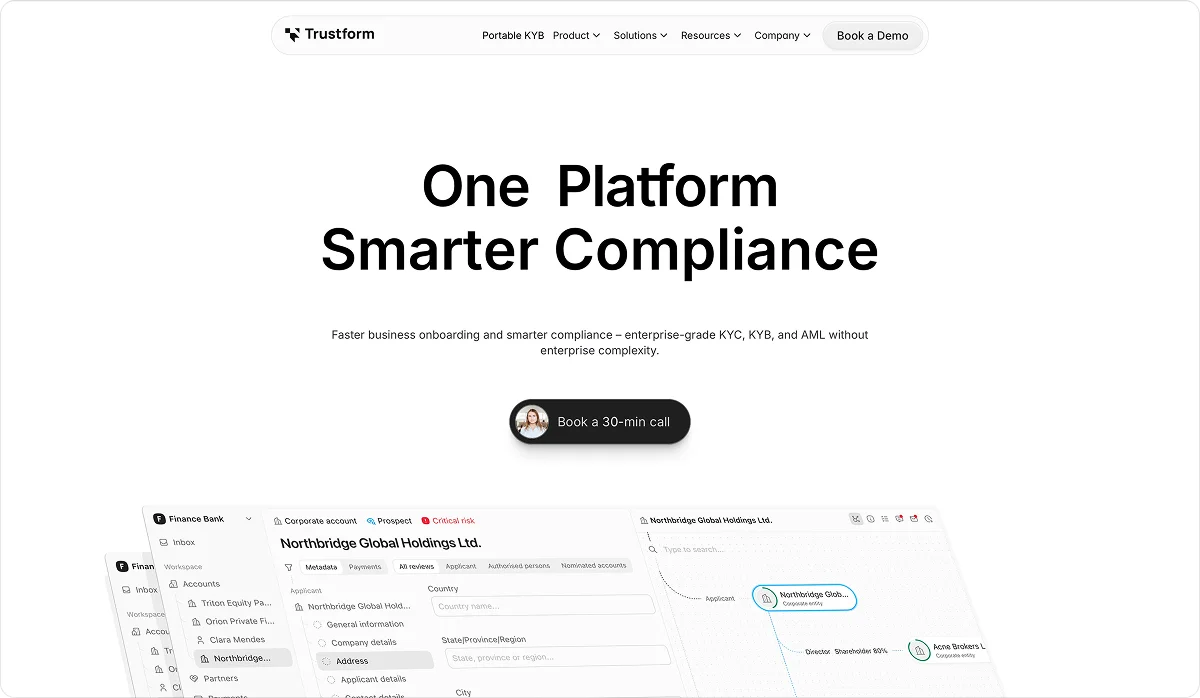
Here are the main benefits our solution brings:
Streamlined customer due diligence: Automate document collection, identity verification, and onboarding processes to accelerate compliance reviews and reduce manual effort.
A single source of truth: Centralise compliance records, communications, and audit trails to support oversight, reporting, and regulatory examinations.
Complex customer structures management: Map beneficial owners, connected entities, and ownership relationships to improve transparency and risk assessment.
Scaled compliance without sacrificing control: Handle growing customer volumes while maintaining consistent due diligence standards and regulatory compliance.
Automated ongoing monitoring activities: Track document expirations, review dates, and compliance obligations with automated alerts and workflow reminders.
Interested to know more?
Book a demo today to see how you can reduce manual AML work and centralise onboarding, due diligence, and monitoring in one platform.
FAQ:
1. What are the four phases of money laundering?
The four phases of money laundering are:
Placement: Involves introducing illicit funds into the financial system
Layering: Involves moving and disguising those funds through complex transactions
Integration: Detects when funds are reintroduced into the economy as seemingly legitimate
Preparation or initial criminal activity: Generates the illicit funds that need to be hidden
2. What are AML guidelines?
AML guidelines are a set of regulatory and industry standards that help organisations prevent, detect, and report money laundering and terrorist financing activities.
They outline requirements for CDD, transaction monitoring, sanctions screening, recordkeeping, and suspicious activity reporting.
These guidelines are issued by national regulators and international bodies to ensure a consistent, risk-based approach to financial crime compliance.
3. How can technology improve AML compliance?
Technology improves AML compliance by automating key processes such as customer screening, transaction monitoring, and risk scoring. It helps organisations detect suspicious patterns more quickly and consistently than manual reviews.
Advanced analytics and AI can also improve alert accuracy, prioritise high-risk cases, and support more efficient investigations and reporting.