


The main compliance challenges in fintechs are fragmented regulation across markets, KYC and KYB checks that must be both fast and thorough, legacy processes split across tools, AI that needs governance, and transaction monitoring that produces too many false positives.
Pressure is rising as the sector grows. Global fintech revenues reached $504 billion in 2025, according to BCG, and compliance expectations have grown with them. As a result, a growing share of fintechs' effort and spend goes on compliance just to be allowed to operate, rather than on product or customers. Much of it is repeat work, with business customers sending the same documents to every provider and each fintech checking them again, which is the work portable KYB is built to cut.
Heavier KYC/KYB loads, rising fraud sophistication, and stricter expectations around AI and data governance create serious challenges.
Because of this, fintechs need more adaptive systems that can support growth without weakening control.
Below, each challenge is paired with practical ways to solve it.
Key takeaways
Fragmented regulations are one of the biggest hidden compliance costs for fintechs
Expanding across jurisdictions creates overlapping AML, CTF, privacy, and reporting rules that are hard to manage consistently. The most effective solution is to centralise regulatory mapping and automate how obligations are translated into controls across markets.Static KYC isn’t enough for modern financial crime risk
One-time onboarding checks miss changes in ownership, behaviour, and sanctions exposure. Fintechs should move to perpetual KYC (pKYC), where customer risk is continuously updated and reviews are triggered automatically when risk changes.Siloed compliance tools create blind spots across the customer lifecycle
When onboarding, screening, monitoring, and case management sit in separate systems, critical risk signals get lost or delayed. A unified compliance platform ensures data flows across all processes and gives teams a complete, real-time risk picture.AI in compliance needs governance before scale
While AI improves onboarding, screening, and fraud detection, regulators increasingly demand explainability and accountability. Without proper model governance, documentation, and human oversight, fintechs risk bias, drift, and regulatory non-compliance.Portable KYB can reduce repeat document collection for business customers
Much of the KYB workload comes from collecting and re-checking the same company information. With portable KYB, a business keeps its company record in a Business Wallet and shares the relevant part when a fintech asks. Trustform offers a Business Wallet for this, while each fintech still runs its own checks and makes its own decision.
What are the main compliance challenges in fintechs?
Below are the key challenges fintechs face and the solutions to overcome them.
Compliance challenges | How to solve them |
Fragmented regulatory requirements | Centralise regulatory change management, standardise controls, and automate regulatory updates across jurisdictions |
KYC and KYB challenges | Replace periodic reviews with perpetual KYC that continuously monitors customer risk and triggers reviews when risk changes |
Inefficient legacy compliance processes | Integrate compliance workflows into a unified, automated platform to eliminate silos and streamline investigations |
AI governance risks | Implement robust AI governance with documented models, continuous monitoring, and human oversight for high-risk decisions |
Transaction monitoring gaps | Combine behavioural analytics, machine learning, and integrated customer data to improve detection accuracy and reduce false positives |
1. Fragmented regulatory requirements
When fintechs expand into new markets, they encounter overlapping requirements across multiple jurisdictions, each with its own expectations around AML, counter-terrorist financing (CTF), consumer protection, data privacy, operational resilience, and financial reporting.
Although these initiatives intend to create greater consistency, they also introduce additional complexity during transitional phases.
Supervisory expectations may change during the transition, which increases the risk of misalignment between interim compliance measures and final regulatory expectations.
Without a structured approach, compliance teams risk relying on manual processes or spreadsheets, which can lead to missed obligations, inconsistent implementation, and gaps that may be identified during audits or regulatory examinations.
How to solve the challenge
To solve a fragmented regulatory landscape, fintechs should build a centralised regulatory mapping system that tracks every relevant obligation by market, product, and legal entity, and then translates those obligations into clear internal controls, owners, and deadlines.
As a result, this reduces the risk of teams interpreting the same rule differently across jurisdictions and makes it easier to update policies when laws change.
Fintechs should use a modular compliance operating model with jurisdiction-specific workflows in addition to a common core process, so onboarding, monitoring, reporting, and escalation can adapt locally without rebuilding the whole system each time.
Automation helps here by standardising task routing, evidence collection, and reporting across markets, which is especially useful when regulatory requirements differ but the control objective is similar.
2. KYC and KYB issues
KYC and KYB processes remain essential for onboarding, but as onboarding volume increases, teams must shorten verification times.
Consequently, they may rely too much on a single kind of check, such as just scanning an ID, or on fully automated systems that make decisions without human review, and miss subtle fraud signals.
The pressure to shorten verification time also comes from customers who expect near-instant access.
This puts fintechs in a tough position: if they prioritise speed, they may onboard high-risk customers, but if they prioritise manual, intensive checks, they damage conversion and the customer experience.
In addition, many fintechs perform KYC and KYB checks only during onboarding, which creates problems because customer risk is dynamic and can change throughout a business relationship.
Customers may enter new markets, change ownership structures, adopt different transaction patterns, or face sanctions or negative media attention after they’ve been onboarded.
How to solve the challenge
The solution is to replace periodic KYC reviews with a perpetual KYC (pKYC) model that continuously assesses customer risk.
This way, instead of waiting for scheduled review dates, perpetual KYC uses automated triggers to detect changes that may affect a customer's risk profile.
These triggers can include significant changes in transaction behaviour, ownership updates, new sanctions listings, PEP status changes, adverse media, or unusual account activity.
When a trigger is detected, the customer's risk score can be automatically reevaluated, so higher-risk relationships receive immediate attention.
A structured risk model makes this possible: risk factors, weights and thresholds are documented, scores are recalculated when a trigger fires, and every change to a score can be traced back to the data that caused it.
This way, you can replace manual, spreadsheet-based risk scoring with a structured, real-time, and auditable risk model that supports configurable scoring models for different customer types.
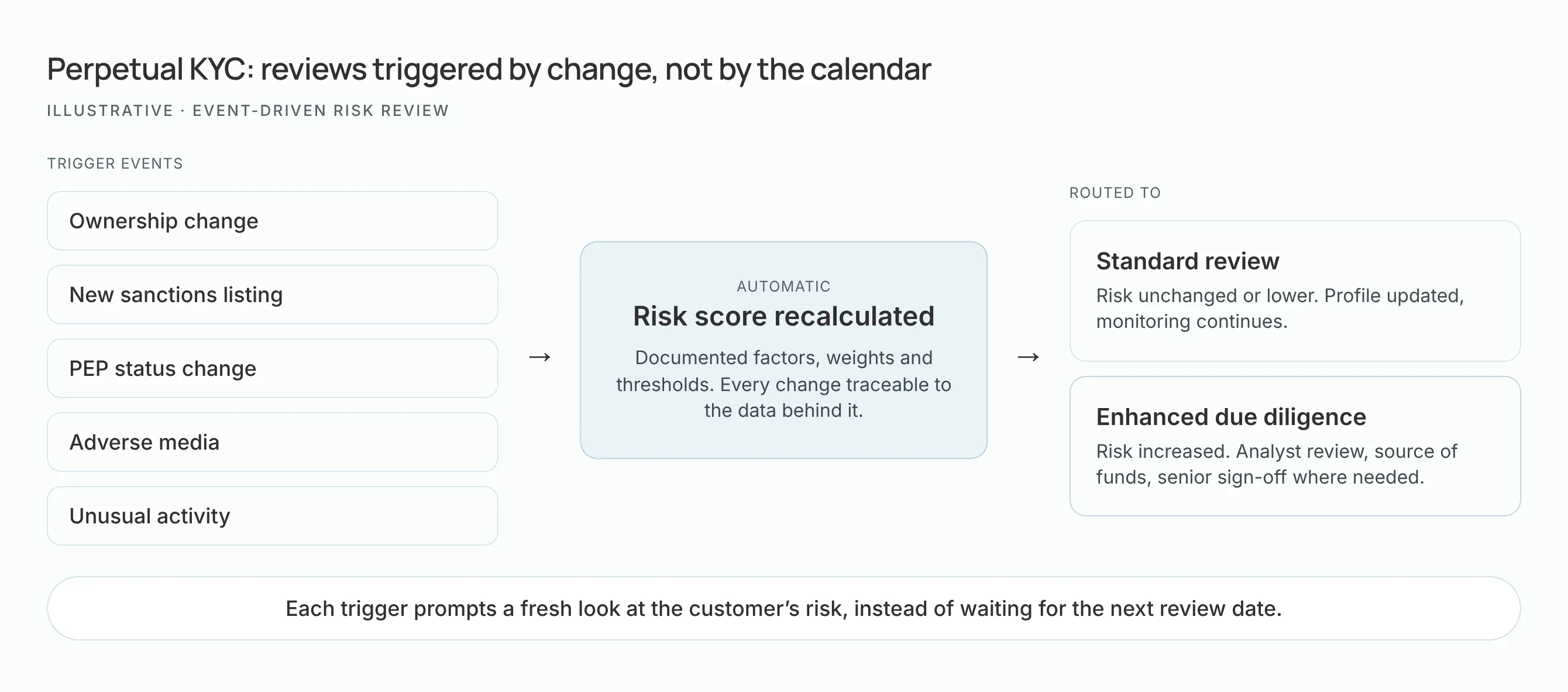
A dynamic, risk-based approach also enables compliance teams to allocate resources more efficiently. They can prioritise enhanced due diligence for customers whose risk has increased, while reducing unnecessary reviews for those whose risk remains stable.
3. Inefficient legacy compliance processes
For many fintechs, onboarding, transaction monitoring, sanctions screening, and case management happen in separate platforms or in separate spreadsheets.
It means they have to re-enter the same information multiple times, reconcile inconsistent records, and track evidence across different owners, which increases the risk of errors, data omissions, and uneven decision-making.
When workflows are siloed, a risk signal identified during onboarding may not automatically move to transaction monitoring, and an alert in monitoring may not update the customer’s risk profile or case history.
Consequently, it leads to duplication, poor visibility, and a more reactive than a proactive compliance functionality.
How to solve the challenge
Addressing these challenges requires fintechs to change fragmented, manual processes into a more integrated and automated compliance operating model.
They need to consolidate compliance workflows into unified platforms that connect onboarding, transaction monitoring, and case management.
Doing so enables information to move across the customer lifecycle, so you can get a complete and updated risk picture when making decisions.
Worth knowing:
Part of the fragmentation starts before onboarding. Business customers send the same registration, ownership and control documents to every bank, payment provider and partner, often in different formats. Trustform offers a Business Wallet in which a company keeps this information as one structured, up-to-date record and shares the relevant part when asked.
For a fintech, this means business information arrives organised and consistent across requests, with sources and dates your team can check.
Your team still screens, assesses risk and decides. Portable KYB changes how the information reaches you, not who is responsible for the decision.
4. AI adoption
AI-powered tools are used to automate customer onboarding, strengthen fraud detection, enhance transaction monitoring, and improve sanctions screening.
However, despite benefits, they also present compliance and governance challenges.
Regulators demand model explainability, fairness, and auditability, but many fintechs lack formal model governance.
In the UK, a 2024 Bank of England and FCA survey found that 75% of financial firms already use AI, but 46% said they have only a partial understanding of the AI technologies they use.
Reasons lie in:
Insufficient policies for model approval
Inconsistent validation processes
Missing training data documentation and feature design
No clear owners for model performance and drift
Without clear explanations, it’s hard to show that decisions are consistent, unbiased, and aligned with regulatory expectations.
How to solve the challenge
The first thing to do is to establish a formal AI governance system that defines how AI models are developed, validated, deployed, and monitored throughout their lifecycle.
You should assign clear accountability, establish approval processes, and define standards for documentation, testing, and ongoing performance monitoring.
In addition, fintechs should regularly assess AI systems for model drift, declining performance, false positive and negative rates, and potential bias across different customer groups.
Comprehensive documentation is also important, and you should maintain detailed records explaining:
How models were trained
What data was used
Which variables influence decisions
How performance was validated
What controls exist to reduce potential risks
Well-documented model governance also enables faster internal reviews and more effective model maintenance.
While AI can quickly analyse vast amounts of data and identify potential risks, decisions involving customer onboarding, account closures, suspicious activity reporting, or enhanced due diligence should still include expert human judgement.
Maintaining a human-in-the-loop approach balances automation with accountability.
5. Transaction monitoring
Effective transaction monitoring is a core aspect of the compliance process, but traditional rule-based monitoring often relies on static thresholds and predefined scenarios that can’t keep up with changing customer behaviour and complex money laundering techniques.
Rules that are too broad can generate large volumes of false positives, so compliance teams spend valuable time reviewing legitimate transactions instead of investigating genuine risks. On the other hand, rules that are too narrow may not identify suspicious activity, which creates regulatory and financial crime exposure.
In addition, rule-based monitoring often lacks true real-time visibility. Many legacy systems operate on batch processes or periodic reviews, so suspicious activities may go undetected.
As a consequence, delayed detection reduces the chance of freezing funds, blocking payments, or collecting timely evidence.
How to solve the challenge
Instead of relying only on static rules, fintechs should adopt monitoring systems that incorporate behavioural analytics and machine learning to identify unusual activity based on changes in customer behaviour.
They can detect subtle anomalies and hidden transaction patterns that traditional rules may overlook, while continuously adapting as customer activity changes.
Risk-based monitoring should also be tailored to different customer segments, products, and geographies.
Performance should be measured using key metrics such as false-positive rates, alert conversion rates, investigation times, and outcomes of suspicious activity reporting to identify opportunities for continuous improvement.
In addition, transaction monitoring shouldn’t operate in isolation.
Integrating customer due diligence, sanctions screening, adverse media monitoring, and case management into a unified compliance system provides the context needed to prioritise alerts more effectively and strengthen overall financial crime controls.
Worth knowing:
Transaction monitoring is only as good as the customer data behind it. For business customers, an up-to-date record of ownership, control and expected activity gives alerts the context they need. Portable KYB, where a company keeps that record current in a Business Wallet and shares updates with the institutions it works with, is one way to stop that context from going stale.
How Trustform's Business Wallet supports portable KYB for fintechs
Trustform offers a Business Wallet: a place where a company keeps its business identity, including registration details, ownership and control information, and key documents with their dates, as one structured, up-to-date record.

Instead of assembling the same file for every fintech, bank or payment provider, the business shares the relevant part of its record when asked.
For fintechs that onboard business customers, the Business Wallet is built to:
Reduce back-and-forth during KYB: business customers can share information that is already organised, rather than collecting documents from scratch
Improve consistency: company information arrives in the same structure across requests, which makes gaps and mismatches easier to spot
Make sources and dates visible: each item can show where it came from and when it was last updated, so your team can decide what to re-check
Support ongoing due diligence: when a company's details change, it can update its record and share the change, rather than waiting for the next periodic review
Keep decisions with you: your team still applies its own screening, risk assessment and approval policy to the information it receives
Want to know more?
See how portable KYB works with the Trustform Business Wallet and what it means for your business customers.
FAQ
1. What data governance practices help fintechs keep customer records consistent across systems?
Fintechs should define a single source of truth for customer data to enable consistent data standards across systems. Regular data quality checks, ownership rules, and integration controls can prevent conflicting records and incomplete risk profiles.
2. How should fintechs use AI in onboarding and transaction monitoring while still meeting regulatory expectations?
Fintechs need clear validation, documented model logic, monitoring for bias, and human oversight for high-impact cases so they can explain outcomes to regulators and auditors.
AI should support decision-making and not replace governance around it.
3. What is the most effective way to scale KYC and KYB checks for high onboarding volumes?
The most effective approach is to use a risk-based onboarding model that applies stronger checks only where risk is higher. Automation can handle low-risk cases quickly, while higher-risk customers are routed to enhanced due diligence or manual review.


