


To improve the client onboarding process, regulated organisations can use AI and automation to collect documents in a structured way, verify people and companies faster, screen for risk consistently, and give clients and teams clear visibility of each step, while keeping human review for higher-risk cases.
Client onboarding in regulated industries is often slow, fragmented and reliant on manual processes that involve multiple teams, systems and compliance checks.
Long onboarding times can frustrate clients before the relationship even begins, while manual compliance workflows increase the risk of errors, missed information, and regulatory exposure.
AI and automation enable organisations to provide a more connected and smoother onboarding process.
Below, we cover the main onboarding challenges, five areas where AI and automation help, and the benefits for clients and compliance teams.
Key takeaways
AI reduces manual effort in identity verification and improves accuracy
AI-powered biometrics and computer vision help organisations speed up onboarding, reduce errors, and free human reviewers to focus on higher-risk cases.Automated data extraction improves speed and data quality across onboarding documents
OCR and NLP technologies extract and validate structured and unstructured data from multiple document types. This way, they help you reduce manual data entry while improving consistency and supporting compliance.KYC and KYB become more scalable and consistent through integrated AI workflows
Automation unifies fragmented checks into API-driven processes, while AI continuously screens sanctions lists, verifies company data, and maps ownership structures, so checks stay current as information changes.Adverse media screening becomes more accurate with contextual AI analysis
AI analyses the context of news coverage, reducing false positives and improving the identification of genuine reputational risks during onboarding.Risk scoring becomes dynamic and data-driven instead of static and manual
Machine learning models evaluate multiple risk indicators and update assessments as new information arrives, allowing low-risk clients to move through onboarding faster while high-risk cases receive deeper review.For business clients, onboarding moves faster when company information arrives structured
Much of the delay in business onboarding comes from collecting the same documents again for every provider. Trustform's Business Wallet lets a company keep its business identity as one up-to-date record and share the relevant part when asked, so automation has cleaner input to work with.
What are the key challenges of traditional client onboarding?
For organisations in regulated industries, client onboarding involves coordinating multiple teams, collecting and reviewing sensitive documentation, verifying identities and ownership structures, and meeting strict regulatory requirements.
When these processes rely on manual work, they can quickly become slow, inconsistent, and difficult to manage.
Here are the main traditional onboarding challenges.
1. Manual document collection
Collecting client documentation still relies on email exchanges, shared folders, and spreadsheets to track submitted files.
Clients may receive multiple requests for different documents over several days or weeks, while relationship managers spend time following up on missing information instead of focusing on higher-value client interactions.
The challenge increases when documents are submitted in different formats or in multiple versions.
Teams must manually determine which file is the latest, verify that all required documents have been received, and ensure that nothing has been overlooked.
As the number of stakeholders increases, so does the risk of duplicated requests, misplaced files, and unnecessary delays.
These manual workflows slow down onboarding and increase the risk of human error.
2. Lengthy verification processes
Once organisations collect documents, they must complete a series of verification and compliance checks before a client can be fully onboarded.
These usually include KYC procedures, AML screening, sanctions checks, beneficial ownership verification, and risk assessments. Each step requires careful review to ensure regulatory requirements are met and potential risks are identified.
Information may need to be reviewed several times before approvals are granted, with each reviewer relying on emails or manual task assignments to move the process forward. If questions pop up or additional documentation is required, the application may return to the client, which creates delays.
While these verification steps are essential for managing risk and maintaining compliance, manual coordination can increase onboarding times.
3. Lack of visibility throughout the onboarding process
Clients often have little insight into where they are in the process, which documents have been approved, or what actions are still required.
Internal teams face similar challenges. When onboarding tasks are managed across emails, spreadsheets, and disconnected systems, it becomes difficult to determine who is responsible for the next step or whether a review is waiting for approval.
Limited visibility also affects operational performance. Managers have fewer opportunities to monitor workloads, measure onboarding progress, or identify recurring delays that could be improved.
Without a centralised view of the onboarding journey, it is difficult to deliver a consistent experience while maintaining the transparency that both clients and regulators expect.
Where do AI and automation improve client onboarding?
AI and automation enhance onboarding by reducing manual effort while improving accuracy and consistency across key stages:
Stage | How AI and automation work |
Identity verification | Use biometrics and computer vision to check IDs, detect fraud, extract data, and match selfies with liveness detection |
Data extraction | Extract and structure data from documents such as passports, certificates, and tax forms, then validate it automatically |
KYC/KYB execution | Connect verification via APIs and screen sanctions lists, verify company data, and map ownership structures |
Adverse media screening | Analyse global news to identify relevant entities, understand context, and filter irrelevant results |
Risk scoring | Assess risk using signals such as geography, ownership, and behaviour to generate dynamic scores |
1. Identity verification
AI-powered identity verification makes this process more efficient by using computer vision and biometric technologies. Advanced systems can automatically:
Analyse government-issued identification documents
Detect signs of tampering or forgery
Extract relevant information for further verification
Facial recognition technology compares the photo on an identification document with a live selfie, while liveness detection helps confirm that the individual is physically present and not using a static image or manipulated video.
By automating these verification steps, organisations can reduce onboarding times while improving consistency and accuracy.
Human reviewers can focus on exceptions or high-risk cases instead of manually processing every application.
2. Data extraction
Collecting information involves reviewing passports, business registration certificates, trust deeds, tax forms, proof of address, shareholder registers, and other supporting documentation before an application can proceed.
AI-powered Optical Character Recognition (OCR), combined with Natural Language Processing (NLP), can quickly and automatically extract both structured and unstructured information from documents.
Instead of simply converting images into text, AI solutions:
Understand document layouts
Identify key fields such as names, addresses, registration numbers, and dates
Validate the extracted information against predefined rules or existing databases
This automation eliminates much of the manual data entry involved in onboarding while ensuring greater consistency across systems.
As a result, organisations can onboard clients more efficiently without compromising data quality or regulatory requirements.
3. KYC/KYB execution
When doing KYC and KYB checks, many organisations still rely partly on manual searches across sanctions lists, corporate registries, and UBO databases to validate client information.
As a consequence, this approach introduces variability in how checks are performed, especially when dealing with complex ownership structures or cross-border entities.
When onboarding volumes grow, these manual processes become difficult to scale without adding operational overhead.
Automation provides a more unified and reliable approach by consolidating verification into API-driven workflows.
AI supports these automated processes by:
Screening individuals and entities against global sanctions and watchlists
Verifying corporate legitimacy through registry integrations
Mapping ownership structures using UBO data sources
Instead of performing these checks in isolation, AI systems integrate them into a single compliance workflow that can be updated as new information comes in.
4. Adverse media screening
Identifying reputational risks is an essential element of client onboarding, especially in industries subject to strict regulatory oversight.
Organisations need to determine whether prospective clients have been linked to financial crime, fraud, sanctions violations, corruption, or other activities that could expose the business to legal or reputational risk.
AI enhances adverse media screening by using NLP to understand the context and meaning of news articles instead of simply matching keywords.
AI models can:
Analyse large volumes of global news sources
Identify references to individuals or organisations
Distinguish between unrelated entities with similar names
Assess whether an article is genuinely relevant to the onboarding process.
Contextual understanding reduces false positives, so organisations can conduct more efficient due diligence, improve the quality of risk assessments, and maintain stronger compliance standards without significantly increasing manual review effort.
5. Risk scoring
Financial institutions, trust companies, and other regulated organisations must evaluate each client's risk profile before establishing a business relationship.
Machine learning enables organisations to perform more dynamic and data-driven risk assessments during onboarding.
AI models can evaluate a wide range of indicators, including geographic location, ownership structure, transaction expectations, business activities, available history (e.g. prior relationships or adverse records), and customer type, to generate an overall risk score.
This way, higher-risk applications go for further review while lower-risk cases move through the onboarding process more quickly.
As additional information becomes available, the assessment can be refreshed to identify applications that require enhanced due diligence. Scores should also be explainable and subject to human oversight.
What are the benefits of AI and automation in client onboarding?
To understand the full impact of AI and automation in client onboarding, here’s how they work together to deliver improvements across the onboarding process.
Outcome area | Automation role | AI role | Combined impact |
Faster onboarding | Automates repetitive onboarding steps such as data transfer, form routing, approvals, and task assignments across systems | Reduces delays by intelligently identifying missing information, predicting next steps, and prioritising high-priority cases | Onboarding moves faster because workflows run automatically while AI reduces decision bottlenecks and prevents back-and-forth |
Better client experience | Sends automated updates, reminders, status notifications, and onboarding instructions at each stage of the process | Personalises communication, adapts guidance based on client profile, and anticipates client needs or confusion points | Clients receive timely, structured communication that is both consistent and relevant |
Improved compliance | Enforces standardised workflows, ensures required steps are completed, and maintains full audit trails of all onboarding actions | Screens clients for risk signals, detects anomalies in data, and highlights cases requiring enhanced due diligence | Automation ensures process integrity while AI improves risk detection quality |
Increased operational efficiency | Eliminates manual coordination between teams by routing tasks automatically and reducing administrative overhead | Supports decision-making by analysing onboarding data, identifying inefficiencies, and optimising workload distribution | Teams spend less time on repetitive coordination and more time on complex, judgement-based work |
How Trustform's Business Wallet supports business client onboarding
Improving client onboarding in regulated environments requires a connected system that unifies document collection, verification, compliance checks, and internal workflows into a single, structured process. For business clients, that process starts with the company information they provide.
Trustform's Business Wallet is a live product for companies. A business keeps its registration details, ownership and control information, and key documents as one structured, up-to-date record, and shares the relevant part with a bank, payment provider, or partner when asked. This approach is sometimes called portable or reusable KYB.
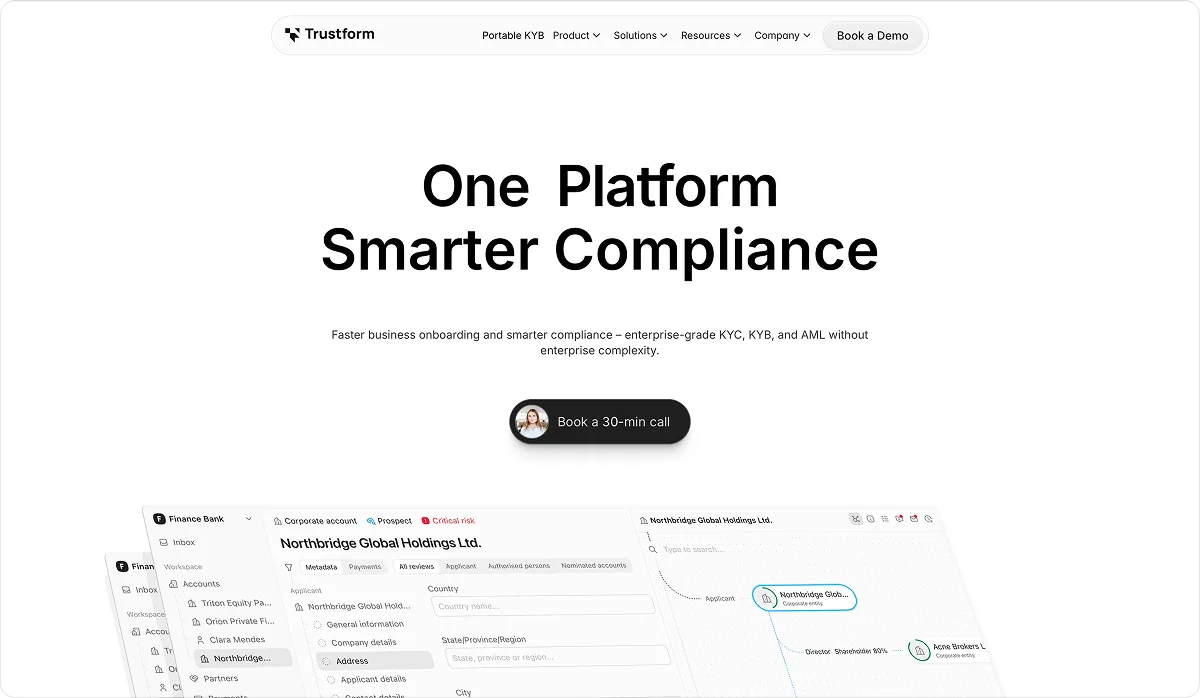
AI and automation work best when the input is consistent. Portable KYB addresses the input side of business onboarding, while each institution keeps its own verification, screening and approval process.
For organisations that onboard business clients, the Business Wallet is built to:
Reduce document chasing: business clients can share information that is already organised, instead of answering the same requests by email
Give automation cleaner input: company data arrives in a consistent structure, which makes extraction, matching and validation more reliable
Show sources and dates: each item can show where it came from and when it was last updated, so reviewers can decide what needs a fresh check
Keep records current between reviews: when a company's details change, it can update its record and share the change
Leave decisions with your team: you still apply your own KYB checks, risk assessment and approval policy
Ready to get started?
Create a Business Wallet to see how portable KYB works for your business clients.
FAQs
1. Why is client onboarding difficult in regulated financial industries?
Client onboarding is difficult because organisations must balance speed, security, and strict compliance checks.
Every step must meet regulatory requirements while still providing customers with a smooth experience.
2. What parts of KYC and KYB onboarding can be automated without reducing compliance?
Parts of KYC and KYB that can be automated include document verification, data capture, sanctions screening, UBO checks, and risk scoring.
Automating routine checks improves speed and consistency, while human review of higher-risk cases and exceptions maintains strong compliance controls and accountability.
3. What are the main compliance risks of using AI in financial onboarding?
The main risks include inaccurate decisions, bias, weak explainability, and poor data handling. Financial institutions also need to ensure that AI systems comply with UK GDPR, support auditability, and meet regulatory and FCA expectations for transparency. For AI risk scoring, this includes the rules on automated decision-making in Articles 22A–D, which the Data (Use and Access) Act 2025 introduced in place of Article 22.
4. Which AI and automation tools are best for client onboarding in regulated services?
The best tools combine identity verification, workflow automation, risk scoring, and integration with existing compliance systems.
The right choice depends on your institution’s size, regulatory scope, and whether you need strong KYC, KYB, or both.
5. How does automation improve compliance during onboarding?
Automation helps teams standardise checks, reduce manual errors, and make it easier to follow consistent review procedures.
It also enables organisations to create clearer records, which support auditability and internal control.
6. How can organisations start using AI in onboarding safely?
They can start with low-risk use cases such as document extraction, form autofill, or basic screening automation.
From there, they can expand gradually while testing controls, governance, and regulatory alignment.


